Charters Aviation is based on accuracy, speed and reliability. A well-coordinated dispatch operation involving people, aircraft, rules, and timing, lies behind each of the smooth private flights. Having knowledge of the charter dispatch workflow would assist operators, brokers and clients to understand the smooth flow of any flight requested and weighed-up. Each stage of the charter flight dispatch process is of paramount value towards safety, efficiency and passenger satisfaction since the process starts with a first inquiry up to a final clearance.
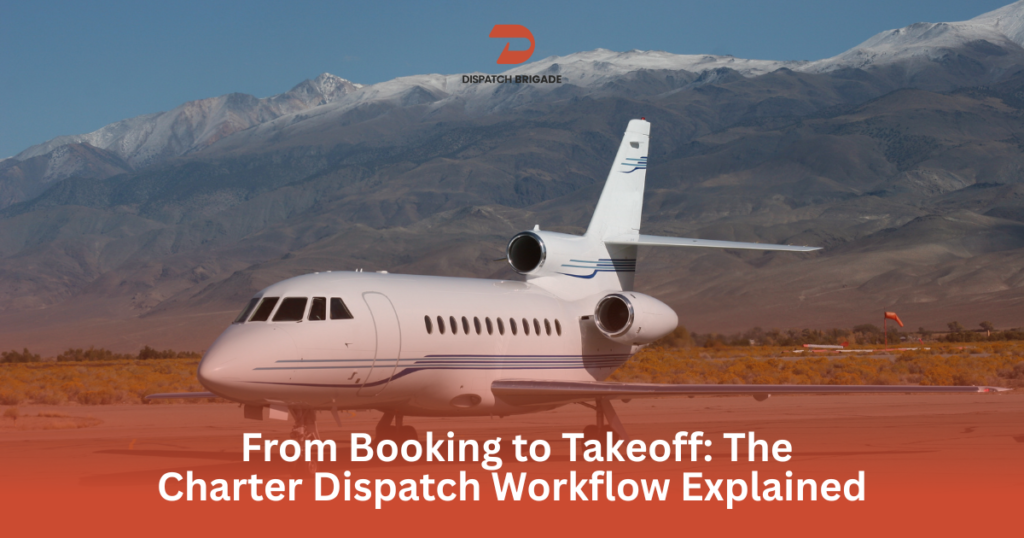
The workflow process starts with the charter flight booking process where a client enters a request with details giving out the travel dates, destinations, number of passengers, and aircraft preferences. At this level, dispatch departments receive necessary trip information and conduct feasibility. This involves checking on the availability of airports, aircraft range as well as runways.
The dispatchers deal with charter sales or brokerage departments to make sure that the requested flight is within the capabilities of operation. Preciseness during this phase avoids delays and has realistic scheduling in further stages of the process.
After the approval of the trip request, the dispatchers proceed to aircraft assignment. In the case of private aviation, the choice of the aircraft is a determining factor to safety and comfort. The personal aircraft dispatch procedure checks the availability of the aircraft and their maintenance, the flight crew and legal clearance.
Before an aircraft is dispatched, dispatchers ensure that the chosen aircraft has the required performance to the desired route such as fuel consumption, weather conditions as well as airport restrictions. The objective of this measure is to make the aircraft ramp ready and the flight continues only when it is mission-ready.
Flight dispatch operations are centrally based on route planning. The dispatchers determine the most effective and safe route to take during flight taking into account the limitations of the air space, the fuel scheme and the weather conditions. State-of-the-art forecasting technology assists the dispatch departments to forecast turbulence, storms, or alternate routes as early as possible.
Analysis of the weather is not a stationary activity and should never cease with the planning of the route. Dispatch teams control conditions till takeoff and during flight, and stand at the ready to make adjustments in the event of change in conditions.
The charter flights have to comply with very strict regulations of aviation. The dispatch teams make sure that all the permits, overflight clearances, landing clearance, and the customs documents are in existence. This is particularly important with international flights because any paperwork that is missed will bring about a lot of delay.
In the charter dispatch procedure, the crew duty limits, rest requirements, and licensing are also checked by the dispatchers to guarantee complete compliance with flying officials.
Communication and crew scheduling are the required factors in dispatch running. A dispatcher verifies the availability of pilots, duty times and the allocation of the trip. The flight briefings conducted to the crews provide information about the route, weather, fuel, passengers and any other special service requirements.
Such coordination is to see that the pilots are well prepared and geared towards the operations expectations before takeoff.
Prior to takeoff, dispatch teams liaise with Fixed Base Operators (FBOs), fuel service providers, catering services providers, and ground handling agents. Such arrangements take care of the aircraft being serviced, fueled and ready in time.
This step in the dispatch process of the private jets directly influences the experience of the passengers, since it determines the efficiency of the boarding operation, the comfort, and on-time performance.
After all the checks are made, dispatch issues the official flight release. This will ensure that an aircraft, crew, route, weather conditions, and documentation are well in compliance with the operational and safety standards.
Staff Dispatchers provide last minute weather checkups, carry-out final reviews, and standby to help the crew. At this stage, the plane is cleared to take off.
Dispatch activities do go on even after takeoff. This allows the dispatch teams to be able to monitor the flight in real time, watch any developing weather conditions and also help with diversions or schedule adjustments in cases where necessary. This provides continuity or support security over the journey.
Professional flight dispatch operations provide the dispatcher as a hub of coordination until the arrival of the aircraft at its destinations safely.
An effective charter flight dispatch procedure minimizes delays, boosts security, perk the customers and shields against operational margins. The workflow is based on one step, which is supported by the other step, and accuracy and communication are also vital in the workflow.
To charter operators, efficient dispatch is not merely a support service, it is a competitive advantage which determines the service quality and reliability.
Successful charter operations are characterised by precision and reliability. Dispatch Brigade provides high-quality dispatch solutions that are aimed at facilitating all the phases of the charter flight process including the booking chain and flight tracking. Partner with Dispatch Brigade to make the dispatch process as efficient as possible and provide charter experiences that are excellent every time.
The dispatch of charters is a highly regulated process that is hard work beginning at the moment of booking, to the moment of takeoff in an attempt to provide clean, safe and on-time flights. Coupled with skillful planning, real time tracking and accurate coordination, the dispatch teams make sure that all charter flights run to the utmost standards.
Dispatch is at the heart of the flight dispatch business since it coordinates aircraft availability, route planning, weather surveillance, regulatory supervision and even crew preparedness. Dispatch provides quality operation, legality and timeliness of every charter flight.
The charter flight dispatching is more flexible and tailored than the airline dispatching. It changes according to the preference of the clients, its changing schedules and exclusive destinations but remains stringent in the safety and regulatory rules.
An organized private jet dispatch workflow will reduce delays and operational risk, and enhance the passenger experience by accurately and efficiently managing every detail, including permits, ground handling, and more.








With extensive experience and a team trained in the nuances of car, truck, and limousine dispatching, we ensure every dispatch is handled with the highest level of professionalism and accuracy.
+1 346-662-1962
info@dispatchbrigade.com
447 Broadway, 2nd Floor 2768 New York
Copyright © 2026 All Right Reserved Dispatch Brigade